Pages

Showing posts with label Class 5º. Show all posts

Sunday, 12 July 2015

Present Perfect Simple or Present Perfect Continuous?


Knorke Regular

Download this worksheet on Present Perfect Simple Or Present Perfect Continuous and solve the activities. Put it in a plastic file and hand it in after the winter holiday. 


Arizonia Regular

Tuesday, 26 August 2014

USED TO - TEST

                Quota Bold

Click HERE to test your knowledge about USED TO. When you finish, click on DONE to see how good you have done it!


Granstander Clean Regular

Margarita in August Regular

Click HERE to continue with your test. Remember to click on DONE to get your result!


Friday, 22 August 2014

THE NATURAL WORLD


KG Broken Vessels Sketch Regular

What is the Natural World?
The natural world is a huge part of our environment. The Earth is under cities and towns. We breathe the air and drink the water that come from the natural world. 

Nevertheless, it is easy to think we live entirely in a man-made world. Cities, towns, homes, schools, cars, roads, computers, among other many things are made by man. But the natural world is all around us, all the time. 

But do we really care of it? In fact, we hurt the environment in more ways than you could possible image.

Floods, droughts, hurricanes, species becoming extinct, melting of the ice, rising of the sea levels, high temperatures are some of the problems the Earth is suffering because of our actions.

Investigate about one of the problems our natural world is experiencing. You can choose one we have mentioned or any other. 

Design a Power Point Presentation (PPP) about it. Use pictures to decorate it. It must include, at least, six slides. 

Click HERE to watch a video my students at Comercial 32 created as a guide.


Wednesday, 8 May 2013

PRESENT CONTINUOUS USE


At this point of your learning, you can write and say sentences in present continuous tense. But how do we use it? Here are some situations when we need this tense:


1° First, we use it for things that are happening at the moment of speaking
examples: 
  • I'm working at the moment.
  • Please call back as– we are eating dinner now.
  • Julie is sleeping.
  • You are studying the present continuous.
He's playing football

2° We can also use this tense for temporary situations, when we feel something won't continue for a long time
   examples: 
  • She's staying with her friend for a week.
  • I'm living in London for a few months.
  • John's working in a bar until he finds a job in his field.
  • I'm reading a really great book. 
They're helping their mother this week because she isn't feeling well.

We can use the present continuous for habits but they have to be temporary or new habits (for normal habits that continue for a long time, we use the present simple)
   examples:
  • He's eating a lot these days.
  • She's swimming every morning (she didn't use to do this).
  • You're smoking too much.
  • They're working late every night.

I'm studying a lot these days because of my exams.

Another present continuous use is for annoying habits, when we want to show that something happens too often and we don't like it. In this case we usually use an adverb like 'always', 'forever' or 'constantly'
    examples:
  • You're always losing your keyes!
  • She's constantly missing the train.
  • He's always sleeping in.
  • They're forever being late.

He's always picking his nose and eating it!

5° Next use is for definite future arrangements (with a future time word). In this case we have already made a plan and we are pretty sure that the event will happen in the future
    examples:
  • My parents are leaving town tomorrow.
  • My plane is arriving tonight at 8.30 p.m.
  • She’s meeting David at the train station tomorrow.
  • They're travelling to Europe next month.
We're going to the theatre tonight. 

The present continuous is also used to talk about trends, that is to say, for general tendencies or inclinations
    examples:
  • More and more people are using their computers to listen to music.
  • Fuel prices are rising constantly because of strong demand.
  • On-line shopping is growing rapidly nowdays.
  • The Universe is expanding.
The population of China is rising very fast.

Finally we use this tense to talk about a situation which is slowly changing
   example: 
  • I'm getting better at playing the piano.
  • The weather is improving.
  •  Global warming is becoming an important issue.
  •  My English is getting better!
    Pollution is getting worse!


WE CAN'T USE PRESENT CONTINUOUS WITH STATIVE VERBS


AND NOW... 

EXECISES!!  

EXERCISE 1

EXERCISE 2

EXERCISE 3

EXERCISE 4

EXERCISE 5 


    Tuesday, 30 April 2013

    ORDER OF ADJECTIVES


    The Order of Adjectives

    In English, most adjectives go before the noun they qualify. The problem comes when there are several adjectives and one has to decide in which order they should go. For example, how would you describe young Ron Weasley, one of the three protagonist in Harry Potter series?


     Young, cute, red-haired, with freckles.

    But how do we know in which order we should write these adjectives in a sentence?

    For English speakers it sounds natural when you say: He is a cute, young, red-haired boy with freckles but if you are not a native speaker you may find it difficult to decide which goes where.

    The grammar rules for adjective order are quite complicated, but if we want to set a more simple rule, we could say that the more subjective the adjective, the farther it is from the noun, while the adjective that best describes the noun goes right next to it.
    So, in the example above, cute is a subjective adjective because it gives an opinion: he may be a cute boy for me, but may look ugly for you. On the other hand, the adjective that best describes him is red-haired, that's why this word should be the one nearer the noun. The word freckles is not an adjective, so we write this particular characteristic after the noun.

    However, things are not always so simple and it's useful to know that the order should be:
    OPINION / SIZE / AGE / SHAPE / COLOUR / ORIGIN / MATERIAL / PURPOSE
    (A mnemonic technique can help you remember this easily: OSASHCOMP)
    Some examples:

    DETERMINER OPINION SIZE AGE SHAPE COLOUR ORIGIN MATERIAL PURPOSE NOUN
    My beautiful
    new
    brown
    woolen
    coat
    A pair of comfortable
    old
    black Italian leather riding boots
    A few talented
    young

    English

    men
    An expensive big
    square

    wooden
    table
    Two cozy


    blue
    cotton sleeping bags


    Take into account that this is not a hard and fast rule, and the position of some adjectives can change for emphasis reasons: breaking the patterns of adjective order can be a powerful way to emphasize one attribute over the other. 

    And now... LET'S PRACTISE!


    These exercises will help you check how much you have learnt:

    EXERCISE 1

    EXERCISE 2

    EXERCISE 3

    EXERCISE 4

    EXERCISE 5 

    EXERCISE 6

    EXERCISE 7


    Friday, 13 July 2012

    DESCRIBING PEOPLE


    HOW TO DESCRIBE PEOPLE

    We all like to think of ourselves as unique individuals. And we are. There is no one exactly like you; you are truly one of a kind. But how do you describe other people? Your best friend? Your favorite cousin? Your teacher?

    After you describe a person's physical characteristics (tall, short, blonde, and so on) it is likely you will begin describing the person's personality traits. (A trait is a distinguishing characteristic or habit.) By naming one or more personality traits, you put the person into a category you are fairly confident your reader or listener will recognize.

    Examples: 
    My brother is a real jock; he lives for sports. 
    My best friend is a fashion guru; she always has the latest styles. 
    My mom is a compulsive cleaner; our house is so organized! 

    As you can see, we do not only use adjectives; we clarify why we consider that person like that. Our minds automatically search for an adjective to describe other ones, but we need to expand out thought. 

    Pay attention to this description:

    Her name is Rihanna. She's my sister. She's a quite tall and thin girl in her early twenties. She has medium length straight black hair and big green eyes. She's got a pale complexion and she looks rather fit. She's a very sociable and friendly girl. She loves speaking to friends and she's always fond of the company of other. She loves Facebook, too. She has many friends all over the world through this social network. I can say that she has a warm, outgoing personality. She enjoys partying, and meeting new people. Her best qualities are that she is trustworthy and generous. Rihanna is a person who I can place my secrets and I can rest assured that she will not betray me. Moreover, she's someone who does things for others without expecting something in return. So, in essence, she is a girl who helps others just because she wants to. In my opinion, her worst faults are that she's a bit disorganized, and sometimes unpunctual. She tends to be late everywhere she goes!

    Click HERE and you will find interesting images and adjectives to describe people.

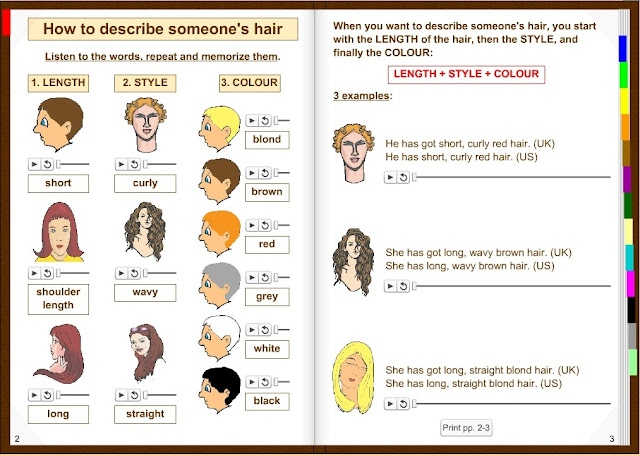
    And now watch an excellent resource to lern how to describe people's appearance. You can hear the words, find matching activities and lots more in this interactive book. I bet you'll master people's description in no time after going through this book.

    This is just a glimpse of what you can find!

     Click HERE to see it!


    MORE PRACTISE ABOUT DESCRIPTIONS!

    EXERCISE 1

    EXERCISE 2

    EXERCISE 3

    EXERCISE 4

    EXERCISE 5

    EXERCISE 6